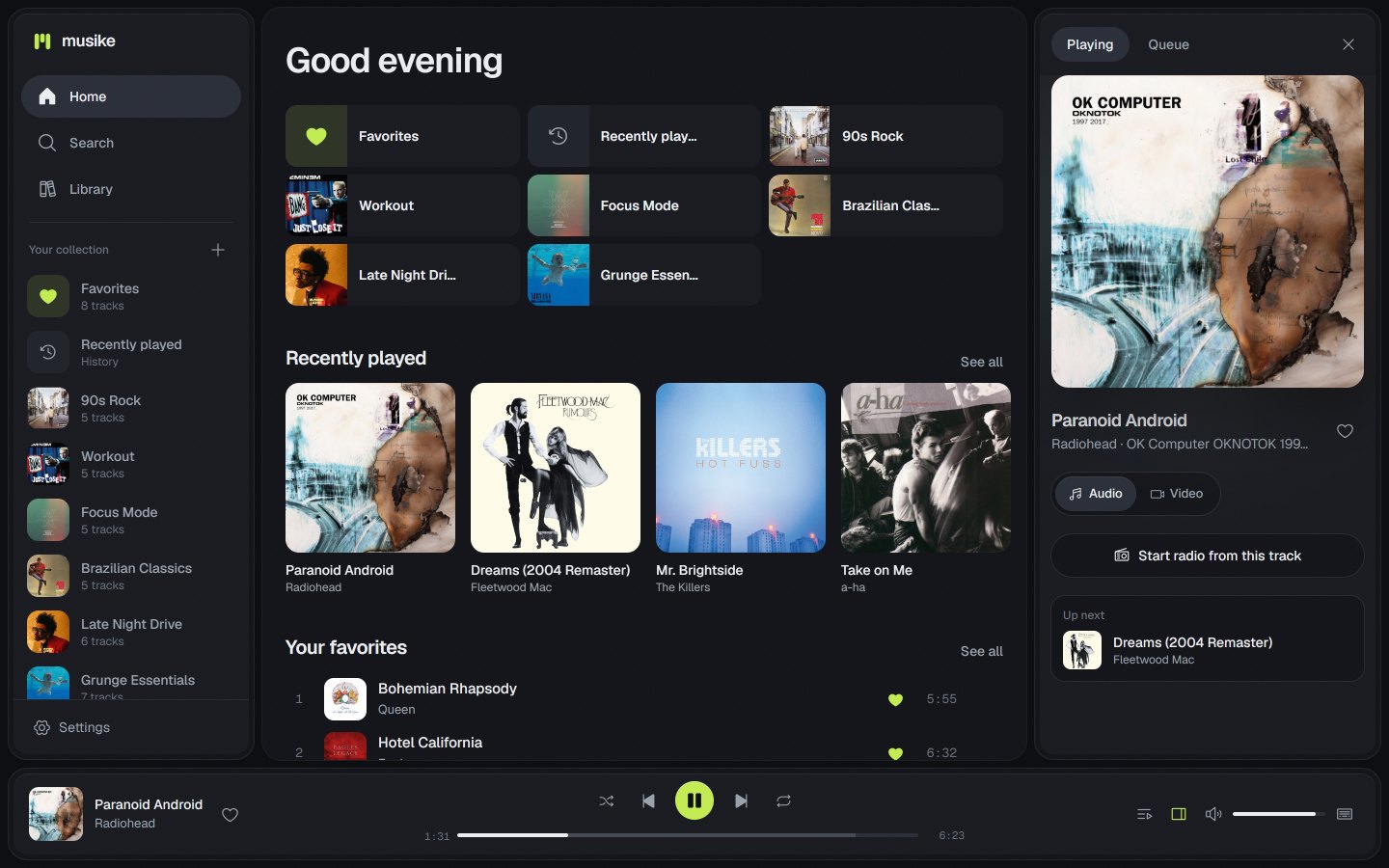
Musike: a free, ad-free player for the YouTube Music catalogue
Musike is an open-source music player that streams from YouTube's catalogue with no ads, no account and no subscription. Songs and music videos arrive in a player built for listening rather than for a video feed. It is MIT licensed.
What it replaces is a paid music tier. If you already search YouTube for music, Musike removes the two things that make that experience bad: the ads, and a player designed around watching.
Which platforms does it run on?
| Platform |
How it runs |
Note |
| Windows |
Installer |
Current user only, no admin rights |
| macOS |
.dmg, Apple Silicon or Intel |
macOS 12 or newer |
| Linux |
.deb or AppImage |
x64 and arm64 |
| Android |
APK |
Android 7 or newer, no computer needed |
| Android TV |
The same APK |
Remote-friendly interface |
| iPhone |
Sideloaded .ipa |
iOS 15 or newer |
| Any browser |
Web app or PWA |
Needs the local server running |
| Docker |
amd64 and arm64 images |
Raspberry Pi supported |
How it works
The catalogue comes from YouTube Music through youtubei.js, which handles search, suggestions, genres, artists, albums and radio. Streams are resolved by yt-dlp, which returns short-lived URLs tied to the IP that asked for them, so the server proxies the bytes and forwards the HTTP Range header. Seeking is instant and audio is never written to disk.
High-definition video, and videos with no combined standard-definition stream, are merged with FFmpeg and cached, least recently played first, up to 2 GB by default. Playlists, favourites and history sit in a single library.json written atomically. The server listens on port 4180.
What it does well
- Search across songs, videos and albums with suggestions as you type, plus YouTube Music's genre browser for when you do not know what you want.
- Albums in their original track order, artist pages with greatest hits and discographies, and autoplay radio that keeps going when the queue ends.
- Audio and video from the same point in a track, with video in a side panel, a floating mini player or a cinema mode that fills the screen.
- Official music videos only, taken from the artist's own channel, so covers and lyric uploads stay out of an album.
- Any accent colour, readable text in either theme, and an English or Brazilian Portuguese interface.
- A backup file any instance can read, so a library moves between Windows, Android and Docker with a merge or replace on import.
- yt-dlp updates from inside the app on a stable or nightly channel, which matters because YouTube changes often.
Where it falls short
- The premise goes against YouTube's terms. The project says so itself: extracting streams to play YouTube content without ads breaks the Terms of Service, and Groovy and Rythm were shut down after notices from Google. It is scoped to personal and educational use, not a public or monetised service.
- YouTube pushes back. Open issues at the time of writing include HTTP 403 playback errors and "Sign in to confirm you're not a bot" prompts on some connections. Turning off a VPN helps, and passing browser cookies works, at the risk of the account being flagged.
- The installers are unsigned. Windows shows "Windows protected your PC" and macOS needs a trip through Privacy and Security before the app opens. An iPhone build has to be re-signed every 7 days on a free Apple ID.
- There is no offline listening and no cloud sync. Downloads and sync are both open feature requests, so every track needs a connection and the library moves by file export.
- It plays YouTube, not your own files. For music you already own, a library organiser is the right tool.
The project is young: first release October 2026, and 1.5.1 published on 20 October 2026.
How to install Musike
Windows, macOS and Linux: run the installer for your system from the releases page. On first launch the desktop app fetches its own yt-dlp, Deno and FFmpeg, about 140 MB, and keeps the library in %APPDATA%\Musike on Windows, ~/Library/Application Support/Musike on macOS or ~/.config/Musike on Linux. Installing over the old version keeps the library.
Android and Android TV: open the APK. No computer and no server, because the app runs the catalogue and playback code on the phone. Audio only for now.
iPhone: install the .ipa with AltStore, SideStore or Sideloadly. It also runs without a server and keeps playing with the screen locked.
Docker: pull ghcr.io/ernani1234/musike:latest, publish port 4180, and mount /data for the library and /cache for video. Run it at home rather than on a VPS, because YouTube blocks datacenter IPs.
From source: Node.js 22.19 or newer, pnpm 10 and a recent yt-dlp, then pnpm install, pnpm build, pnpm start.
Is Musike legal?
Running Musike is legal: the code is MIT licensed. Using it to strip ads from YouTube content goes against YouTube's Terms of Service, which the project states in its own legal notice. That places it with ad blockers and downloaders rather than with licensed streaming services.
FAQ
Is Musike free? Yes. MIT licensed, no paid tier, no account, no subscription. The only cost is the hardware you run it on.
Does it need a YouTube account? No, it reads the public YouTube Music catalogue. An account only enters the picture if you pass browser cookies to get past a bot check.
Does it work without a computer? On Android, Android TV and iPhone, yes. Those apps talk to YouTube directly, while the desktop and browser versions run a local server.
Will it keep working as YouTube changes? Mostly, as long as yt-dlp is current. The app updates yt-dlp in one click from Settings, and playback errors offer the update button inside the notice.
How does it compare with the other free YouTube tools here? YouTube Music is the service itself, free and ad-supported. SmartTube does the ad-free job on a television. Cobalt saves files rather than playing them. Musike is the one that behaves like a music app.
For the wider picture of replacing paid subscriptions, read free alternatives to popular paid subscriptions. For a library of files you own, the Lidarr listing covers the organiser end.
Last checked: November 2026. Licence and legal notice read from the repository, release details from v1.5.1, and the failure modes from the project's open issues at the time of writing.